Unveiling the Velociraptor Skull Fossil: A Comprehensive Guide to Understanding This Cretaceous Predator’s Anatomy

Description:
Welcome to our in-depth exploration of one of paleontology’s most iconic specimens: the fossilized skull of a Velociraptor mongoliensis, preserved in its natural rock matrix. This guide is designed to provide a professional, step-by-step analysis of the fossil, much like a tutorial for aspiring paleontologists, collectors, or enthusiasts. Whether you’re a student of natural history, a museum curator, or simply fascinated by dinosaurs, we’ll break down the key features, historical context, scientific significance, and preservation techniques associated with this remarkable artifact. By the end of this post, you’ll have a thorough understanding of how to identify, interpret, and appreciate such fossils, complete with practical tips for examination and display.
Step 1: Visual Identification and Initial Assessment
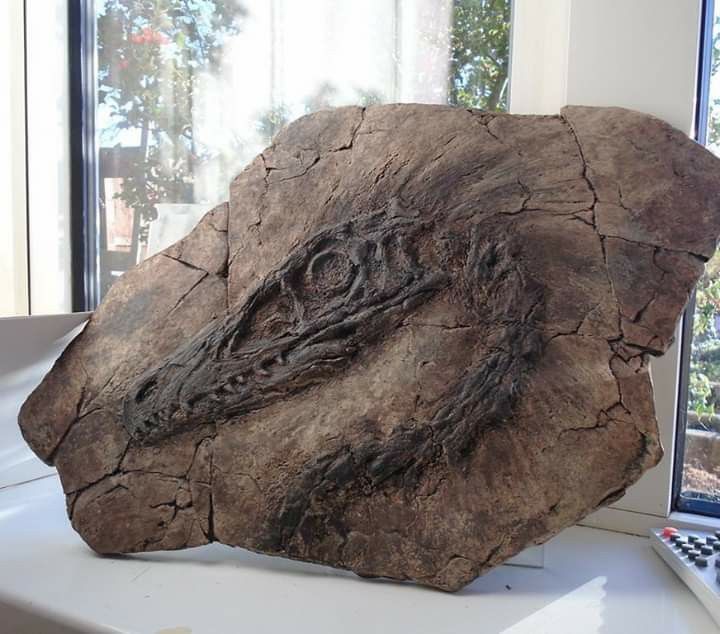
Begin by examining the overall appearance of the fossil. The specimen in question is embedded in a irregularly shaped slab of brownish sedimentary rock, likely from the Djadochta Formation in Mongolia, where many Velociraptor fossils have been discovered. The rock matrix measures approximately 30-40 cm across at its widest points, with natural fractures and cracks that add to its authenticity—these are typical of fossils excavated from arid, wind-eroded desert environments.
The skull itself is prominently displayed in left lateral profile (side view), curving slightly upward toward the rear, which may indicate the natural death pose or post-burial compression. Key identifying features include:
- Snout and Jaw Structure: The elongated, narrow snout (rostrum) extends forward, measuring about 20-25 cm in length. It tapers to a pointed tip, ideal for a carnivorous diet. Look for small, serrated teeth along the upper and lower jaws—these are sharp and recurved, designed for gripping and tearing flesh. In this specimen, several teeth are visible, embedded in the matrix, showcasing the heterodont dentition (varying tooth shapes) common in dromaeosaurids like Velociraptor.
- Orbital (Eye) Socket: A large, circular eye socket dominates the mid-section of the skull, approximately 5-7 cm in diameter. This suggests keen binocular vision, essential for a predator hunting in low-light conditions or coordinating pack behaviors. The socket’s size relative to the skull (about 20-25% of the total length) indicates a creature adapted for agility rather than brute strength.
- Nasal and Antorbital Fenestrae: Above the snout, you’ll notice openings (fenestrae) that reduce skull weight without sacrificing structural integrity. The antorbital fenestra, a large hole in front of the eye, is a hallmark of theropod dinosaurs, aiding in jaw muscle attachment and airflow.
- Cranial Rear and Neck Attachment: The back of the skull transitions into what appears to be the start of the cervical vertebrae (neck bones), curving gracefully. This area shows fine bone textures, possibly indicating muscle attachment points for quick head movements.
Tip for Identification: Compare this to other theropods like Deinonychus or Troodon. Velociraptor’s skull is more slender and bird-like, distinguishing it from bulkier tyrannosaurids. If you’re handling a similar piece, use a magnifying glass to check for bone grain—genuine fossils often show porous textures, while replicas may be smoother.
Step 2: Geological and Historical Context
To fully appreciate this fossil, understand its origins. Velociraptor lived during the Late Cretaceous period, approximately 75-71 million years ago, in what is now Central Asia. Fossils like this one are typically found in the Gobi Desert’s red sandstone layers, formed in a semi-arid floodplain environment prone to flash floods—which explains the excellent preservation through rapid burial.
The first Velociraptor specimen was described in 1924 by Henry Fairfield Osborn, based on a skull and claw from Mongolia. Famous discoveries, such as the “Fighting Dinosaurs” specimen (a Velociraptor locked in combat with a Protoceratops), highlight their predatory lifestyle. This particular skull style—embedded in matrix—mirrors museum-quality pieces from expeditions by the American Museum of Natural History and Mongolian Academy of Sciences.
Practical Tutorial Tip: If researching a fossil, cross-reference with databases like the Paleobiology Database or apps like Fossil Identifier. Note the formation: Djadochta’s fine-grained sands preserve delicate details, unlike coarser matrices from North American sites.
Step 3: Scientific Significance and Anatomical Insights
Delve deeper into what this skull reveals about Velociraptor’s biology. As a dromaeosaurid (“raptor”), it was a small (about 2 meters long, 15-20 kg) but intelligent predator, with a brain-to-body ratio suggesting advanced cognition—possibly pack hunting, as inferred from multiple specimens found together.
- Feeding Habits: The long snout and sharp teeth indicate a diet of small mammals, lizards, and other dinosaurs. The jaw’s kinetic (flexible) structure allowed for wide gapes and precise bites.
- Sensory Adaptations: The large eye socket implies acute vision, potentially with color perception similar to modern birds (Velociraptor’s descendants). Scleral rings (bony eye supports, not visible here but common in replicas) would have protected the eyes during hunts.
- Evolutionary Links: This skull exemplifies theropod evolution toward birds—note the lightweight construction and air-filled bones (pneumatization), reducing weight for speed.
Research Insight: CT scans of similar skulls reveal air sacs extending into the bones, a trait shared with modern avians. This fossil helps debunk myths from films like Jurassic Park—real Velociraptors were feathered, turkey-sized, and far from the scaly giants depicted.
Tutorial Exercise: Sketch the skull and label parts (e.g., maxilla, jugal, quadrate). Use online resources like 3D models from Sketchfab to rotate and study.
Step 4: Preservation, Authenticity, and Display Techniques
This specimen appears to be a high-quality cast or replica, given its clean presentation on a white surface with modern background elements (e.g., a window and remote control). Original fossils are rare and often housed in museums, but replicas allow widespread study.
- Authenticity Check: Genuine fossils may show mineralization (e.g., iron staining), while fakes use resin. Test with UV light—real bones fluoresce differently.
- Preservation Methods: Fossils are prepared using tools like air scribes to remove matrix without damaging bone. Acid preparation (e.g., with acetic acid) reveals fine details.
- Display Tips: Mount on a stable base to prevent cracks. Use indirect lighting to highlight textures—avoid direct sun to prevent fading. For home display, consider a glass case with humidity control (40-50% RH) to mimic museum conditions.
Tutorial Step-by-Step for Replica Creation (If Interested): 1) Mold the original using silicone. 2) Cast in polyurethane resin mixed with pigments for realism. 3) Embed in artificial matrix (plaster-sand mix). 4) Weather with paints for aged look.
Step 5: Broader Implications and Further Reading
This Velociraptor skull fossil serves as a portal to the Mesozoic era, illustrating predator-prey dynamics and evolutionary adaptations. It underscores the importance of ethical fossil collection—always source from reputable dealers to avoid black-market trade.
For deeper dives, recommended resources:
- Books: “The Rise and Fall of the Dinosaurs” by Steve Brusatte.
- Museums: Visit the American Museum of Natural History’s Velociraptor exhibits.
- Online: Explore the Dinosaur Institute at the Natural History Museum of Los Angeles County.
By following this tutorial-style breakdown, you’ve gained professional-level insights into this fascinating specimen. If you have your own fossil images or questions, share them in the comments—we’d love to analyze them together!