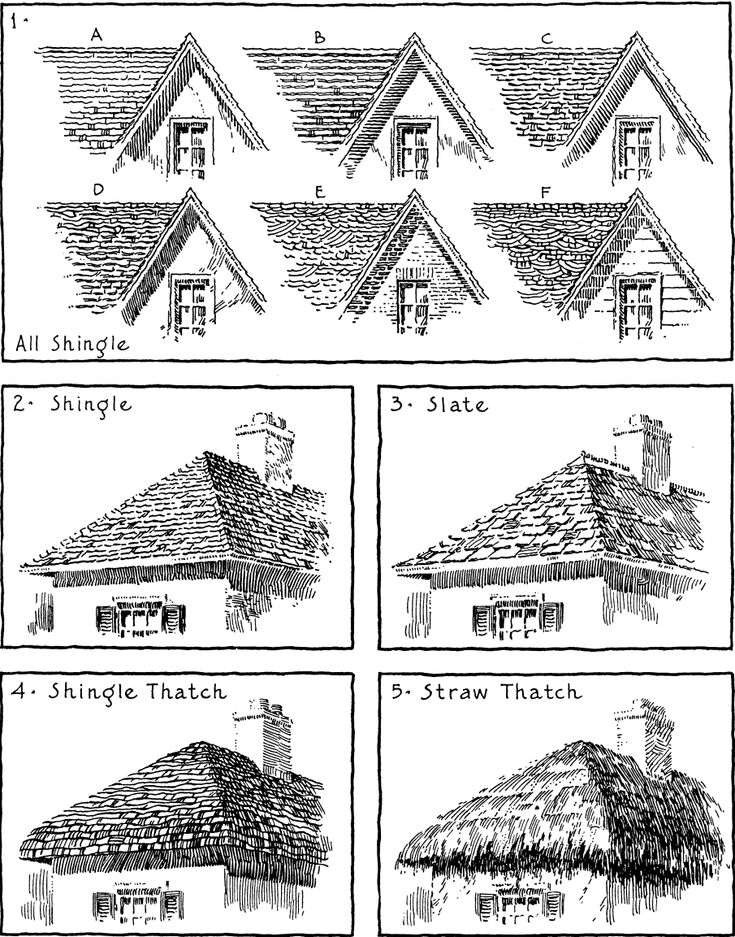
Roof Design Masterclass: Shingle, Slate, and Thatch Systems – A Professional Guide to Authentic Architectural Detailing in Concept Art & Illustration

Description (Long-Form Tutorial Post):
Elevate your architectural concept art, environment design, and visual storytelling with this comprehensive roof typology masterclass. From medieval cottages to industrial warehouses, the roof is the crowning silhouette of any structure—dictating era, climate, culture, and material logic.
This tutorial, based on classic architectural drafting principles, breaks down five distinct roofing systems across shingle, slate, and thatch categories. Each example includes line weight hierarchy, texture application, and narrative cues—perfect for game art, animation backgrounds, matte painting, and production illustration.
Why Roof Design Matters in Visual Development
A roof isn’t just a hat—it’s a character-defining element:
- Shingles → Vernacular, temperate climates
- Slate → Refined, durable, urban or institutional
- Thatch → Primitive, rural, organic decay
Master these systems, and your buildings will read instantly at any distance or fidelity.
PART 1: ALL SHINGLE – Pitch & Pattern Variations
Goal: Understand how shingle scale, overlap, and pitch affect readability and structural logic.
| A. Steep & Uniform | B. Moderate & Staggered | C. Low & Dense |
|---|---|---|
| High pitch, tight rows | Balanced pitch, offset joints | Shallow pitch, heavy overlap |
| Alpine/chalet | Classic farmhouse | Coastal/low-country |
| D. Broken Rhythm | E. Worn & Patchy | F. Ornate Edge |
|---|---|---|
| Irregular rows | Missing/damaged shingles | Scalloped or diamond tips |
| Aged, lived-in | Abandoned/decay | Victorian detail |
✅ Shingle Best Practices:
- Overlap 40–60% of each course
- Stagger joints (never align vertically)
- Vary line weight: thicker at ridge, thinner at eave
- Weathering: darker at bottoms, lighter at ridge (water staining)
❌ Avoid:
- Perfectly straight rows on curved roofs
- Uniform thickness across all shingles
- No pitch variation (all roofs look identical)
PART 2: SHINGLE – Full Building Integration
Focus: How shingles wrap chimneys, dormers, and eaves.
✅ Do This:
- Cricket detailing behind chimneys (diverts water)
- Flashing lines at wall-roof junctions
- Overhanging eaves with exposed rafters
- Shadow traps under deep overhangs
Pro Tip: Use cross-hatching density to suggest shingle granularity—dense at shadow, sparse in light.
PART 3: SLATE – Precision & Permanence
Goal: Convey weight, rigor, and longevity.
✅ Slate Characteristics:
- Rectangular tiles, uniform size
- Minimal overlap (25–30%)
- Sharp, clean ridges
- Chimney integration with lead flashing
✅ Rendering Techniques:
- Hard edges with thin, consistent lines
- Subtle value shifts per tile (avoid flat gray)
- Highlight ridge caps for structural clarity
Narrative Use: Slate = wealth, institution, or cold climate.
PART 4: SHINGLE THATCH – Organic Decay
Goal: Capture volume, texture, and time.
✅ Thatch Anatomy:
- Thick eave buildup (bird nesting zone)
- Irregular surface (hand-bundled reeds)
- Sagging ridge (weight + age)
- Chimney smoke erosion (darkened ring)
✅ Drawing Approach:
- Layered scribble strokes (follow roof contour)
- Darker at base, lighter at ridge
- Break silhouette with stray straw
- Add moss/lichens in shadow pockets
PART 5: STRAW THATCH – Primitive & Wild
Goal: Maximum organic chaos with structural intent.
✅ Straw vs. Shingle Thatch:
| Shingle Thatch | Straw Thatch |
|---|---|
| Neater bundles | Wild, untamed |
| Flatter planes | Extreme volume |
| Longer lifespan | Prone to fire/rot |
✅ Advanced Detailing:
- Netting or wire to hold bundles
- Animal damage (bird holes, rot patches)
- Smoke staining around chimney
- Vegetation growth (grass on roof)
The Roof Design Decision Matrix
| Climate | Era | Class | Recommended System |
|---|---|---|---|
| Cold, wet | Medieval | Peasant | Straw Thatch |
| Temperate | Colonial | Middle | Shingle (staggered) |
| Cold, urban | Victorian | Wealthy | Slate |
| Coastal | Modern | Working | Shingle (dense) |
Professional Workflow: From Thumbnail to Final
| Stage | Tool | Focus |
|---|---|---|
| 1. Silhouette | Hard round brush | Pitch, chimney placement |
| 2. Structure | Thin liner | Rafters, ridges, flashing |
| 3. Texture | Custom shingle/thatch brush | Material-specific strokes |
| 4. Weathering | Smudge + eraser | Stains, moss, damage |
Common Pitfalls & Fixes
| Problem | Fix |
|---|---|
| Roof looks flat | Add ridge caps + eave shadows |
| Material unclear | Use stroke direction (shingle = horizontal, thatch = diagonal) |
| Chimney floats | Draw cricket + flashing |
| Too clean | Add 3–5 damaged tiles/straw patches |
Downloadable Assets
- [Roof Brush Pack (ABR)] – 15 shingle, slate, thatch brushes
- [PSD Layer Template] – Pre-organized (Silhouette → Structure → Texture)
- [Reference Sheet PDF] – 50 historical roof examples
Available for download below / Patreon exclusive
Tutorial by: [Your Studio/Name] – Architectural Concept Art & Worldbuilding Based on principles from: Traditional Drafting & Environment Design
Build roofs that tell stories. One shingle at a time.